Odyssey Ai-One Putter Still Worth Buying After Ai-DUA
The Odyssey Ai-One putter spent two years as the most talked-about flatstick in golf, and in 2026 it has a successor sitting right beside it. Odyssey launched the Ai-DUAL range on 23 January 2026, which leaves a practical question for anyone shopping today: is the original still the smart buy? The answer depends on what the AI-designed insert actually did, what Ai-DUAL changed, and how much the price gap is worth to your stroke.
Why Three-Putts Became a $25 Million Problem
Odyssey’s pitch started with a number. The brand calculated that its staff players’ three-putts cost them a combined $25 million in a single year, and its analysis pointed to poor speed control as the main culprit. Distance, not line, was costing money.
The trigger was mishits. Callaway’s R&D team found that ball speed was the top factor in three-putt rates, and that off-center contact was the main variable behind it. A putt struck a few millimeters from the sweet spot comes off the face at a different speed, and over 40 feet that is the difference between a tap-in and a nervy comeback putt.
The fix borrowed from Callaway’s driver playbook. Engineers told computers to test different materials, insert shapes and designs, aiming at more consistent ball speeds even on off-center hits. The result reached stores in late 2023, and Jon Rahm had already put one in play ahead of that year’s Ryder Cup.
What the Ai-One Insert Does, and Where the 21% Comes From
The headline claim is that putts finished 21% closer to the hole on average in robot testing, using a 15-point face map from 32 feet against a popular rival putter. That is a manufacturer’s figure from a controlled test, not a promise about your Saturday round. Still, the method is specific enough to take seriously.
The construction is straightforward. The AI-designed contours sit on an aluminum backer that is co-molded to a White Hot urethane striking surface, so the putter keeps the familiar soft feel. A see-through window on the putter shows off the contoured topology on the back of the insert. Odyssey also added a lighter shaft: the SL 90 carries 20 to 30 grams of counterbalance weight in the butt end.
The milled version takes a different route. Ai-One Milled pairs a stainless steel body with a milled titanium insert and claims putts finish 10% closer than a typical milled putter, which is a smaller gain than the standard model’s 21%. The extra money buys a firmer, more refined feel rather than a bigger accuracy jump.
From Five Shapes to a Full Family
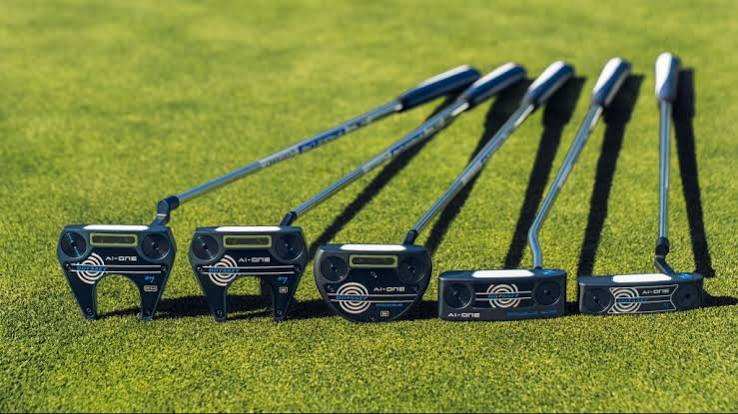
The line began narrow and grew quickly. The launch covered five Ai-One head shapes, including the #1, Double Wide DB, Rossie S, #7S and #7CH, with more promised. Odyssey delivered: eight new models arrived in 2024, including the Wing Back, the 24 and two 2-Ball Jailbird versions.
That breadth is the Ai-One’s quiet advantage today. Blade, mallet and high-MOI buyers can all find a shape that suits their stroke, and the counterbalanced Cruiser models cover those who want extra stability. Today’s Golfer’s 2026 test sessions left its reviewer saying any premium putter shopper should at least trial an Odyssey AI model.
Ai-DUAL Arrives: What Changed and What Didn’t
Ai-DUAL keeps the AI-driven approach and targets the original’s weak spot. Testing showed the Ai-One struggled to produce forward spin low on the face, sometimes even creating negative spin. The new insert answers with a dual-layer urethane build, a soft outer layer over a firmer inner layer, plus grooves sloped 19 degrees for a quicker, cleaner roll. Odyssey reports more than 25,000 AI simulations and 72 physical prototypes behind it.
Early verdicts are positive with caveats. Golf Digest gave the Ai-Dual blade a gold medal on its 2026 Hot List, though some testers found the very soft insert tricky for distance control and left putts short. That is a notable wrinkle, because distance control was the Ai-One’s whole selling point. Today’s Golfer found the Ai-DUAL’s roll more aggressive than the Ai-One’s.
The Price Question: New Ai-DUAL or Discounted Ai-One?
At launch, the Ai-ONE listed at $299.99 and the Ai-ONE Milled at $449.99. Ai-DUAL’s UK price of £299 puts it in the same neighborhood as the original’s launch price. The Ai-One itself remains on the shelf as part of Odyssey’s conventional lineup, while one retailer guide says used Ai-One models are going for roughly $150 to $200 as golfers upgrade. Treat used prices as a rough guide, since they shift with condition and shaft.
My read: if you want the firmest, most predictable speed control and a lower price, the Ai-One still makes a strong case. If you prefer a livelier roll and the newest technology, Ai-DUAL is the one to try. Either way, putt both before deciding.
Questions Golfers Are Asking
Is the Odyssey Ai-One putter actually more forgiving?
Odyssey’s own robot testing says so, with putts finishing 21% closer to the hole on average from off-center strikes. Forgiveness here means speed consistency across the face, not a larger head, so even small blade shapes benefit.
What is the difference between Ai-One and Ai-One Milled?
The standard version uses an aluminum-backed urethane insert, while the Milled model has a titanium insert and a fully milled stainless body. The standard model’s claimed benefit is bigger, and the Milled costs more for its feel.
Is the Ai-One discontinued now that Ai-DUAL exists?
Not as far as the sources show. The Ai-ONE range is still listed as a flagship conventional line alongside the new releases, though stock and availability vary by retailer.
Which Ai-One shape should a beginner choose?
Mallets like the #7 and Jailbird offer more stability, since the #7 style’s perimeter weighting helps mishits keep their speed. Slight-arc strokes often suit blades, so a fitting is worth the time.
The Bottom Line
The Odyssey Ai-One putter changed how golfers think about forgiveness by chasing speed consistency instead of bigger heads. Ai-DUAL refines the idea, but the original remains a proven, widely available choice, now with a price edge. Test both on the same green and trust the one whose distance control feels natural.