AI Excuse Generator Best Uses, Real Risks in 2026
Need to cancel on someone and can’t find the words? There’s an app for that now. Actually, dozens. Free iPad apps, no-signup websites, a Chrome extension. Every AI excuse generator promises the same thing: a believable reason, in seconds. Fun, mostly. The catch is that one extension also makes fake photos, a flooded basement for example, to back the story up, and employers are already fed up with AI-forged evidence. So where’s the line? That’s what this piece is about.
Fake Photos First: Where an Excuse Becomes Evidence
It started with a Chrome extension for people who want to skip work for a football match. The pitch: write the excuse, then attach a completely fake photo to prove it. A flooded basement. A burst pipe. Whatever the developers had in mind, that’s forgery, not a white lie.
A text can be denied later. A doctored image can’t.
Employers are primed for this. Expense platform AppZen said AI-generated receipts made up 14% of the fraudulent documents it saw in September 2025, and human reviewers often couldn’t tell them from real ones. Law firms are putting out deepfake guidance for HR teams, and a Connecticut business group is telling companies to name AI misuse outright in their written policies.
Courts are moving too. Proposed changes to the Federal Rules of Evidence would require authentication of AI-generated material, including a proposed new Rule 707. For an ordinary employee, the bottom line is simple. Attach fake proof to a sick-leave request and it may be treated as falsifying records. “The app made it” isn’t a defense.
What an AI Excuse Generator Actually Hands You
Now the harmless side. Excuse Generator AI, a free iPad app, lets you choose Work, Social, Travel or “Just Stay in Bed,” then a style: sarcastic, dramatic, poetic, conspiracy-level. Fifteen languages. Pure entertainment.
NotMyFault wants to be useful instead. Describe the situation, pick Professional, Casual, Funny or Emergency, and it returns short, medium and long versions, adjusted for a boss, a client or a partner. Its reply handler is the telling bit, because it helps you stay consistent when someone writes back. That’s where excuses die.
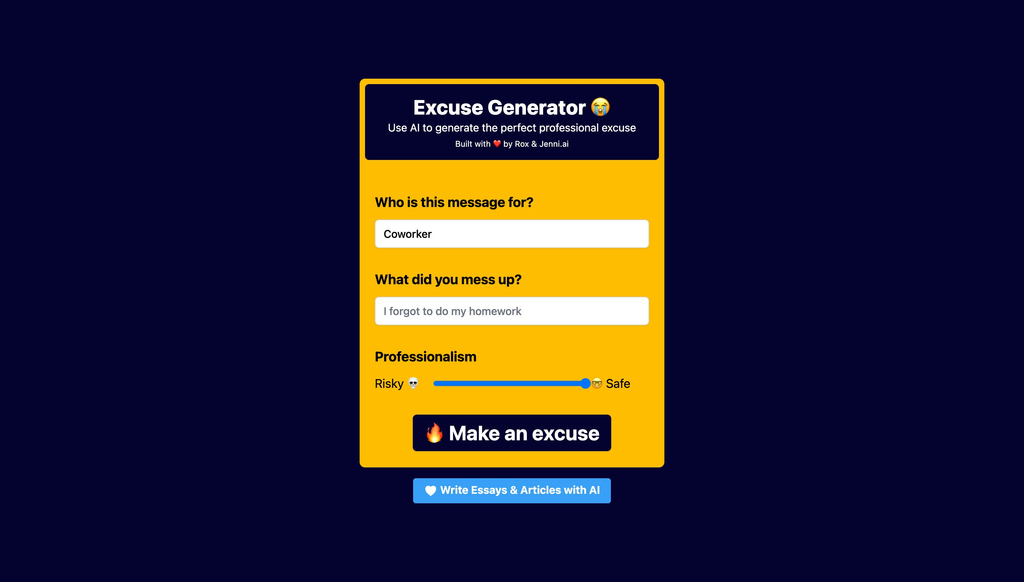
Jenni.ai’s tool keeps it simple with “Risky” and “Safe” modes.
Strip away the branding and every AI excuse generator is a prompt in a nice wrapper. One Hugging Face demo runs a small Gemma model with a 60-token cap and asks for excuses that are concise, unexpected and “difficult to disprove.” Read that last phrase twice.
Funny, Believable or Risky? Choosing Your Tool
Excuseify is new, free, and needs no account. It splits its tones into two jobs. “Believable” is the default, for real moments when the words won’t come. “Dramatic” and “Absurd” are for the group chat. The maker says nothing is stored and that the idea is to say a true thing well, not invent a crisis.
Any AI excuse generator is decent at tone. Awkward becomes polite in seconds. But it doesn’t know your week, so facts are your job. Start with something true, cut the invented bits, keep it short.
Why short? Old CareerBuilder surveys, from before generative AI so treat the numbers as dated, found about 30% of workers had called in sick while healthy, and roughly a third of employers had checked. Doctor’s notes, phone calls and, for about a quarter, social media. The numbers are old but the pattern isn’t. Long stories attract questions.
Five Minutes of Editing Beats Five Minutes of Lying
Then edit. ZeroBounce surveyed 750 employees and 250 managers. Of the employees, 24% use AI for workplace emails daily and 35% have used it for something sensitive. What gives it away? 59% said language that’s too formal or robotic, and half said unnatural word choice. A flawless excuse can look suspicious all by itself.
So start from a real reason, even a vague one like “something came up.” Never attach generated proof. Rewrite the draft in your own voice, the way you’d actually type it. And check privacy before pasting anything personal, since the iPad app’s store listing says usage data may be used to track you.
Quick Answers: Four Things Readers Ask
Is an AI excuse generator really free?
Mostly. The iPad app, Excuseify and Jenni.ai’s tool all advertise free use, and Excuseify doesn’t want an account. Free isn’t the same as private, so check what each one collects.
Can using one get me fired?
The text alone, rarely. A lie that comes apart, yes. Employers verify absences through notes, calls and social media, and a fabricated photo is a much bigger problem than a vague message. If the real reason is private, “personal matter” beats a story you have to maintain.
Which AI excuse generator should you try first?
Depends what you need. Jokes: the iPad app. Work messages in different lengths, with follow-up help: NotMyFault. A plain, believable draft without signing up: Excuseify.
Can people tell it was written by AI?
Often, yes. Survey respondents named stiff, robotic phrasing as the top giveaway. Shorten it, use your own words, keep details tied to your real situation.
The Short Version
An AI excuse generator is a drafting aid, not an alibi. Use it to find kinder, clearer words for something true, or to get a laugh in the group chat. It can’t save a made-up story from a follow-up question, and it can’t protect you if you back that story with fake proof. Keep the core honest. Let the tool do the phrasing. Leave the doctored photos alone.